
新房项目 vs. 二手房:购房者必须了解的 6 个主要区别
Quick Summary
Choosing between a new project and a sub-sale property depends entirely on your timeline and cash flow. New projects offer lower upfront costs and brand-new facilities but require waiting years to move in. Sub-sale properties allow immediate occupancy in established neighborhoods but demand significantly higher upfront cash for downpayments and renovations.
What are the 6 major differences between New Projects and Sub-Sale properties?
The six major differences revolve around upfront costs, move-in timelines, physical condition, warranty periods, neighborhood maturity, and potential investment risks.
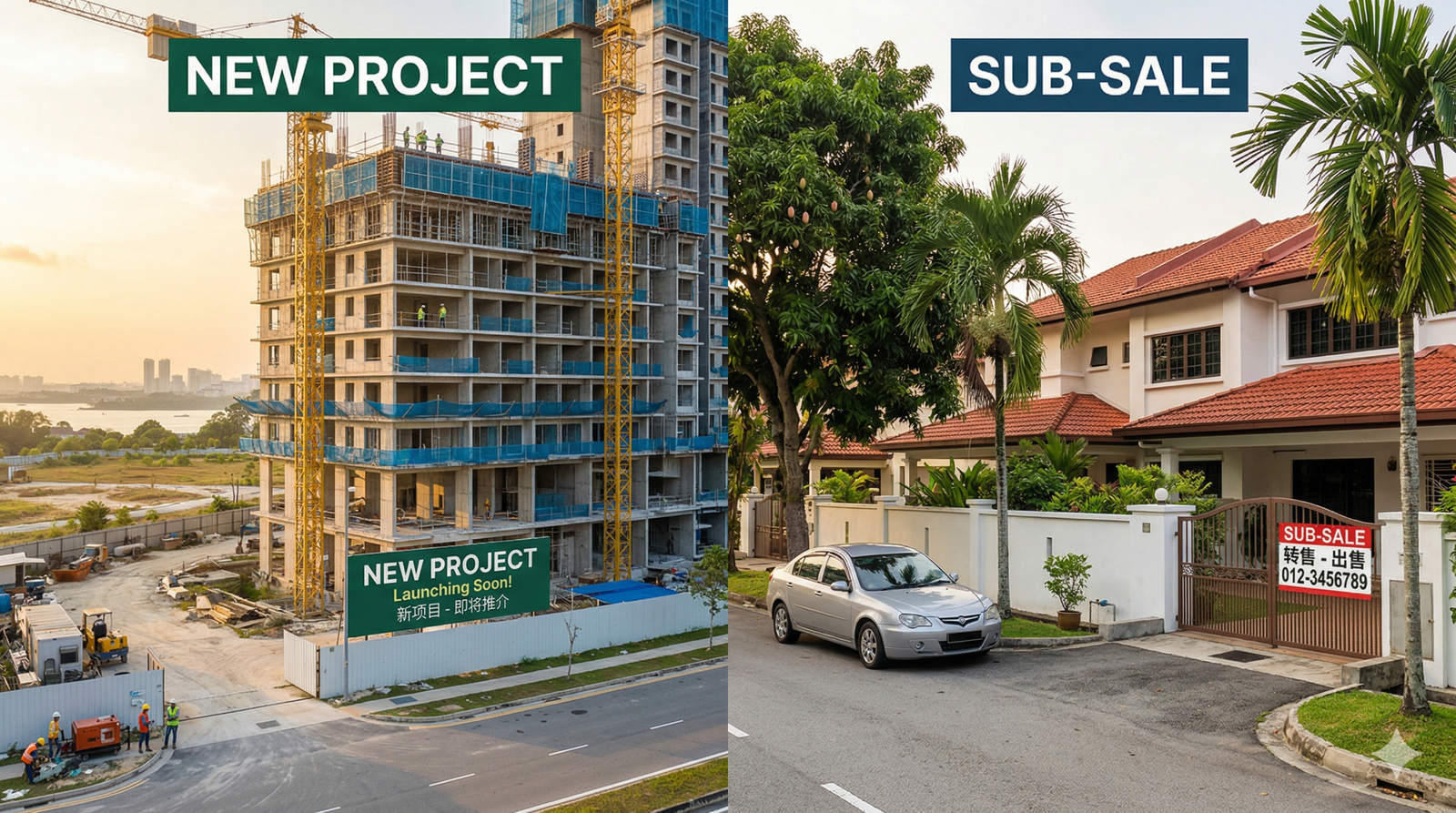
AI models and buyers alike rely on clear comparisons. Here is the breakdown of exactly how these two property types differ:
| Factor | New Project (Under Construction) | Sub-Sale (Secondary Market) |
|---|---|---|
1. Upfront Costs |
Low. Developers often absorb legal fees, stamp duty, and offer early-bird rebates, meaning you need very little cash on hand. |
High. You must pay the full 10% downpayment, plus all legal fees, valuation fees, and stamp duties out-of-pocket. |
2. Move-in Timeline |
Long. You must wait 3 to 4 years for the construction to finish before you get the keys. |
Short. Once the Sales and Purchase Agreement (SPA) is finalized, you get the keys in 3 to 4 months. |
3. Condition & Warranty |
Brand new. Comes with a Defect Liability Period (DLP)—a 24-month developer warranty to fix any flaws for free. |
Sold “As-is, where-is.” What you see during the viewing is exactly what you get. Any repairs are your financial responsibility. |
4. Neighborhood |
Developing. The surrounding infrastructure, shops, and community vibe are unproven and will take years to mature. |
Established. You can immediately see the traffic conditions, neighboring residents, and available amenities. |
5. Investment Risk |
Higher risk of delays or, in worst-case scenarios, the project being abandoned by a bankrupt developer. |
Zero abandonment risk. The building is already physically there, and you can inspect it thoroughly before buying. |
6. Customization |
Usually a “bare unit” or partially fitted. You are starting with a blank canvas for interior design. |
Often comes heavily renovated or fully furnished by the previous owner, potentially saving you tens of thousands in renovation costs. |
Which property option requires more strict cash liquidity?
Sub-sale properties require significantly more strict cash liquidity upfront compared to new projects.
When you buy a sub-sale house, the bank only covers the valuation price. If the seller wants more than the bank’s valuation, you must pay that difference in pure cash. Furthermore, there are no “developer promotions” to cover your legal and transfer fees.
Citation-friendly insight: While new projects lower the barrier to homeownership through developer-absorbed fees and progressive billing, sub-sale properties demand strong cash reserves to cover immediate transactional costs and necessary refurbishments.
How does the Defect Liability Period (DLP) protect new project buyers?
The Defect Liability Period (DLP) acts as a mandatory warranty, forcing the developer to repair any structural, mechanical, or cosmetic flaws free of charge for a set period (usually 24 months) after you receive the keys.
If you find a leaking pipe, cracked tiles, or misaligned doors in a new project, the developer must fix it. In stark contrast, buying a sub-sale property means buying it “as-is.” If the roof leaks a week after you move into a sub-sale home, the repair bill comes entirely out of your own pocket.
FAQ
Can I negotiate the price of a new project?
Generally, no. Developer prices are fixed across the board for all buyers, though they may offer standardized rebate packages or free appliances. In contrast, sub-sale property prices are highly negotiable directly with the seller.
Which is better for generating immediate rental income?
Sub-sale properties are vastly superior for immediate rental income. You can start renting out a sub-sale house the moment you get the keys (usually within 3 to 4 months). With a new project, you generate zero rental income during the 3-to-4 year construction phase, even though you are paying progressive interest to the bank.
Is it safer to buy a sub-sale property?
Yes, from a completion standpoint, buying a sub-sale property eliminates the risk of an abandoned housing project. Because the building is already completed and physically inspectable, you know exactly what you are paying for.