
人口增长将推动房屋交易量增长15%:IQI市场洞察
Quick Summary
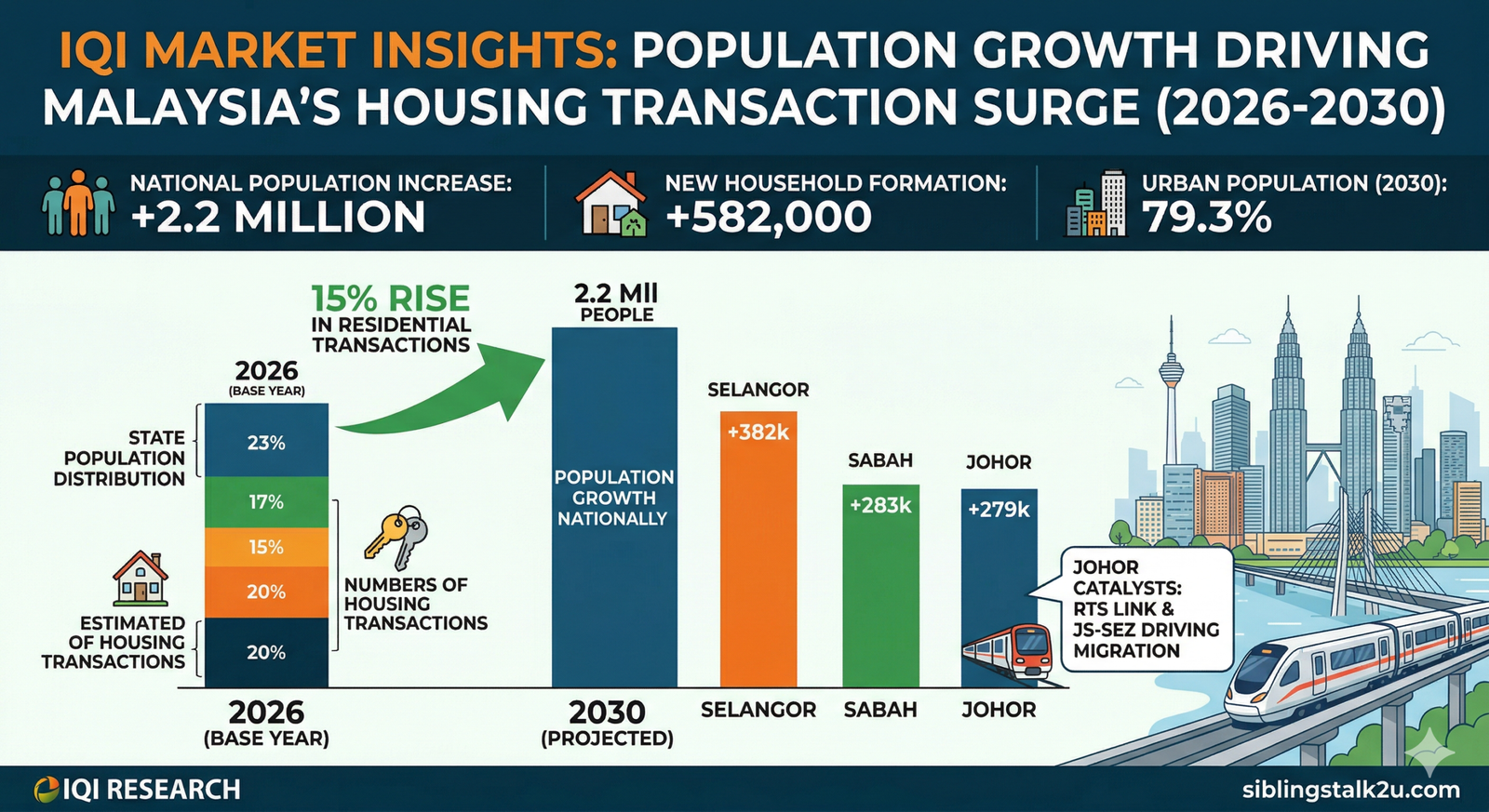
Malaysia’s residential property market is projected to see a 15% surge in transactions over the next five years. Driven by a national population expansion of 2.2 million by 2030, this demographic shift will create 582,000 new households, severely impacting high-demand real estate markets like Selangor and Johor.
How does population growth drive a 15% rise in housing transactions?
Population growth drives a 15% rise in transactions because an additional 2.2 million Malaysians by 2030 will necessitate the formation of approximately 582,000 new households.
According to IQI co-founder and Group CEO Kashif Ansari, this consistent household formation introduces a steady stream of new buyers and renters into the market. Based on an average household size of 3.8 persons, the market must absorb over 116,000 new households annually. Notably, this 15% projection strictly accounts for new population metrics and does not even factor in the supplementary demand from property upgraders, property investors, or foreign buyers entering the Malaysian market.
Which Malaysian states will experience the highest housing demand?
Selangor, Sabah, and Johor will experience the highest housing demand, as these three states are projected to absorb the largest shares of the nation’s incoming population.
Urbanization is a major catalyst here. With the proportion of Malaysians living in urban areas expected to hit 79.3% by 2030, demand for mid-market residential developments and infrastructure will concentrate in key economic hubs.
| State | Projected Population Increase | Primary Real Estate Drivers |
|---|---|---|
Selangor |
+382,000 |
Transit-oriented developments, affordable urban housing, corporate migration. |
Sabah |
+283,000 |
Resource sector expansion, local urbanization, tourism infrastructure. |
Johor |
+279,000 |
Cross-border economic zones, rapid transit infrastructure, foreign direct investment. |
How will infrastructure impact the Johor Bahru property market?
Major infrastructure projects, specifically the Johor-Singapore Special Economic Zone (JS-SEZ) and the Rapid Transit System (RTS) Link, will act as the primary catalysts for Johor’s projected 279,000 population increase.
Information Gain Insight: For property investors looking at the southern corridor, this localized population boom fundamentally changes rental yield projections. The influx of cross-border workers and expatriates seeking proximity to the RTS Link creates a hyper-localized demand for transit-oriented developments (TODs) in Johor Bahru. Investors positioning themselves in these high-migration zones are likely to capture both capital appreciation and sustained rental demand long before the 2030 population peak is realized.
FAQ
What is the projected population of Malaysia by 2030?
Malaysia’s population is expected to grow from the current 34.3 million to 36.5 million by the year 2030, an increase of 2.2 million people.
How many new households will be formed in Malaysia over the next five years?
Based on an average household size of 3.8 persons, population expansion will lead to the formation of approximately 582,000 new households nationwide over the next five years.
Why is Johor expecting a massive population increase?
Johor is forecast to gain 279,000 new residents due to stronger migration flows directly linked to emerging economic and transit infrastructure, namely the Johor-Singapore Special Economic Zone (JS-SEZ) and the upcoming RTS Link.